

A dental clinic, a car showroom, a co-working space and a restaurant all want a coffee machine, and almost nothing about their requirements overlaps. One needs four drinks a day made by a receptionist between patients; another needs two hundred made by trained staff under pressure. Choosing a coffee machine for business use starts by identifying which of these situations you are actually in, because the machine follows from that rather than from a budget.
Who Operates It Changes Everything
The single most useful question is who will press the buttons. Where trained staff operate the machine as part of their job, a traditional espresso machine is viable and produces the best results available. Where the operator is a receptionist, a client, or forty different employees, automation is not a compromise but a requirement. Machines chosen without answering this question end up either underused because they are intimidating, or producing poor drinks because nobody was trained.
Cafes and Restaurants
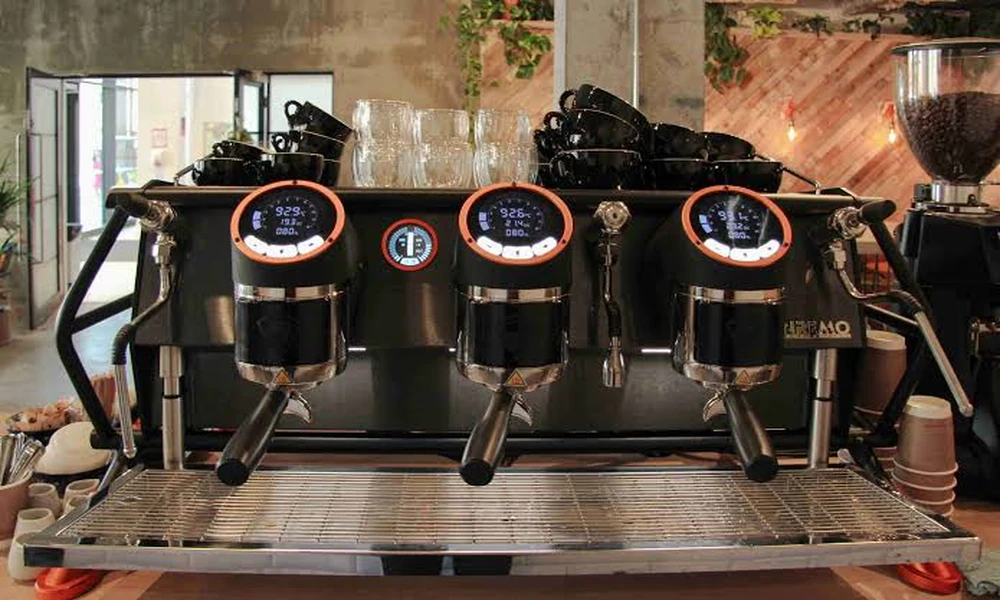
Here coffee is a product being sold, so quality and speed under pressure both matter, and the equipment is expected to run all day. A traditional multi-group espresso machine with a separate high-quality grinder is the standard, operated by staff who have been trained. Specification centres on boiler capacity, recovery under sustained load, and build quality for continuous duty. This is the one category where the machine’s ceiling matters more than its ease of use.
Hotels and Serviced Apartments
Requirements split. Front-of-house and lounge service resembles a cafe. In-room provision is a different problem entirely, prioritising simplicity, safety and consistency for guests who will not read instructions, which usually means capsules or a simple pod system. Breakfast service benefits from batch brewing for volume alongside a machine for made-to-order drinks. Treat each as a separate specification rather than seeking one machine for the property.
Clinics, Showrooms and Client-Facing Spaces
Volume is low, unpredictable and matters disproportionately, because the coffee forms part of a client’s impression. Speed and reliability beat sophistication: a machine that produces a decent flat white in forty seconds at the press of one button suits a receptionist with a waiting client far better than one requiring judgement. Presentation matters too, since the machine sits in a space clients see. Capsules are entirely defensible here despite the cost per cup, because the volume is small.
Co-Working and Shared Spaces
High volume, entirely self-service, and used by people who have no relationship with the equipment. This is the most demanding environment for reliability and hygiene, because nobody feels responsible for the machine. Fully automatic units with automated rinse and cleaning cycles, robust construction, lockable settings and a large grounds container are essential, and someone on the operator’s staff must own the daily routine. Providers of business coffee solutions should be asked specifically about their experience in unattended environments.
Retail and Convenience Formats
Where coffee is sold as a side line rather than a core product, the requirement is a machine producing acceptable drinks quickly with minimal staff involvement, ideally self-service. Cup counters and consumption reporting matter here because the coffee is a revenue line to be understood. Footprint is usually tight, and the machine has to fit a counter designed for something else, so measure before shortlisting.
Sizing Against Peak, Not Average
Whatever the setting, the number that matters is demand at the busiest moment: the morning rush, the post-lunch period, or the fifteen minutes after a session ends in a co-working space. Ask for the cycle time on a milk drink and how many consecutive drinks the machine produces before it needs to recover. A machine sized on daily totals will disappoint at exactly the moment people notice.
The Practical Constraints
Three things quietly decide the shortlist. Whether the location has a water supply and a drain, since plumbing removes the daily filling that otherwise gets forgotten. Whether the electrical supply can carry the machine, as larger commercial units need a dedicated circuit or three-phase. And the physical space, measured including height clearance to open the hopper and the room needed behind for ventilation and servicing.
Service Is the Long-Term Variable
For a business, a machine that stops is a service failure in front of customers or staff. Ask what preventive servicing is included, what response time applies and whether it covers your trading hours including weekends, whether a loan machine is provided, and where parts are held. Matched to the operator, the setting and the peak, and backed by a supplier who answers those questions clearly, a coffee machine for business use becomes an asset nobody has to manage rather than a recurring problem.