

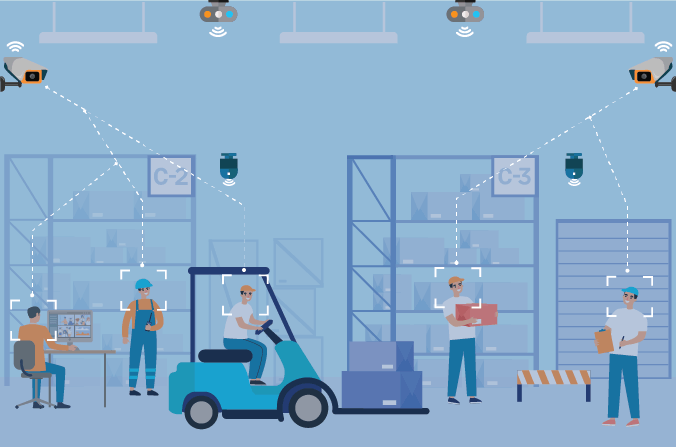
Warehouse managers depend on reliable information to maintain efficient, predictable, and safe operations. Smart sensors now provide that information with greater consistency than manual observation ever could. When deployed thoughtfully and evaluated through an operational assessment early in the process, these technologies strengthen performance and help teams prevent disruption before it begins.
Smart sensors vary widely in design and function. Some monitor equipment conditions, others track movement, and many serve as a digital layer that connects people, processes, and machinery. Their value grows as warehouses become more complex and as customers expect higher levels of accuracy and service.
Limiting Collision Hazards
Lift truck traffic continues to be one of the most significant safety concerns in warehouse environments. Smart sensors help limit these risks by providing real time alerts when vehicles approach pedestrians, fixed structures, or other machines. These systems often rely on proximity indicators that trigger visual or audible signals when operators near restricted zones.
The result is more controlled movement across busy aisles. Drivers respond to alerts with greater awareness, and pedestrians gain an added layer of protection when visibility is compromised. The reduction in collisions translates to fewer injuries, less equipment repair, and fewer interruptions to production.
Strengthening Equipment Reliability
Mechanical issues can escalate quickly when they go unnoticed. Sensors mounted on conveyors, autonomous equipment, and lift trucks track temperature, vibration, alignment, and component strain. This information helps maintenance teams prioritize repairs before small issues become major failures.
Early intervention reduces unplanned downtime and supports more predictable scheduling. It also influences parts purchasing and long term equipment planning. When managers understand how components behave under varying loads or conditions, they can build maintenance routines that extend equipment life and improve daily reliability.
Improving Environmental Conditions
Environmental control plays a central role in product quality and employee well being. Temperature, humidity, and air quality sensors provide ongoing readings instead of periodic checks. When conditions drift outside acceptable ranges, alerts notify managers immediately.
This level of oversight is important for facilities handling food, pharmaceuticals, or moisture sensitive goods. It also protects employees from working in areas where air quality or temperature could create fatigue or discomfort. By adjusting airflow, equipment placement, or insulation based on sensor feedback, managers maintain a stable environment that supports accurate, efficient work.
Increasing Inventory Accuracy
Inventory accuracy influences nearly every warehouse function. Smart sensors contribute to accuracy by tracking product movement through receiving, storage, picking, and shipping. Radio frequency tags, scanners, and sensor enabled identification systems update records automatically as items flow through the facility.
This reduces manual scanning errors and shortens search time when items are misplaced. With more precise visibility, replenishment becomes easier to plan, and pickers encounter fewer exceptions. Over time, this strengthens the overall dependability of the operation and reduces the operational cost of investigating discrepancies.
Supporting Ergonomic Safety
Repetitive motion and improper lifting techniques lead to preventable injuries. Wearable sensors give managers insight into how employees move throughout their shifts. These devices detect bending, twisting, and lifting patterns that may strain muscles or joints.
Supervisors can then coach employees in safer methods or adjust tasks that create unnecessary fatigue. The result is a healthier workforce and fewer injury related absences. Reducing physical strain also supports productivity because employees maintain consistent performance throughout the day.
Creating a More Informed Operation
Smart sensors help warehouse teams base decisions on current data rather than assumptions or incomplete information. Managers can monitor equipment load, traffic flow, order volume, and environmental conditions simultaneously. Access to real time information improves labor planning, equipment utilization, and workflow adjustments.
As teams grow more comfortable working with this data, the operation becomes more proactive. Issues are addressed earlier, and supervisors gain confidence in decisions that once required guesswork. Gradually, the organization builds a culture that values measurable performance and continuous improvement.
Integrating With Warehouse Systems
The true value of smart sensors emerges when their data connects with warehouse management systems and automation platforms. Integration creates a unified network that reflects the actual conditions on the floor. This improves coordination between receiving, inventory control, picking, and shipping.
Because updates occur automatically, the information employees use is accurate and current. This reduces delays, eliminates manual corrections, and strengthens communication between teams. As integration improves, managers can build more advanced reporting and analytics that expose patterns not visible through manual review.
Guiding Long Term Automation Planning
Sensor data offers a clearer picture of where automation may provide measurable value. Traffic patterns, congestion points, equipment strain, and workflow inconsistencies become easier to understand. These insights help managers select automation equipment based on real needs rather than assumptions.
This reduces uncertainty during capital planning and improves the long term success of automation projects. When decisions are grounded in measurable conditions, equipment is easier to justify and integrate.
Enhancing Workforce Engagement
Employees benefit from clear expectations and predictable workflows. Smart sensors support these conditions by reducing confusion, providing consistent feedback, and limiting the frustration that arises from preventable delays.
When workers feel safer and more informed, their engagement often improves. This leads to better communication, stronger adoption of new processes, and fewer challenges during periods of high demand. Increased engagement also reduces turnover, which supports productivity and lowers training costs.
Building Toward Higher Productivity
Safety and productivity often improve together when sensors are used effectively. Fewer collisions reduce downtime, better equipment insight limits breakdowns, and improved environmental control stabilizes workflow quality. Inventory accuracy reduces rework and supports faster order processing.
These benefits compound over time, creating a warehouse environment that performs consistently even during volume spikes. Managers gain greater confidence in their planning, and employees work within a system that supports accuracy rather than relying on constant adjustments.
Smart sensors continue to evolve, but their core value remains the same: more accurate information and better control over daily operations. Warehouses that invest in sensor technology gain the ability to operate with greater precision and to make decisions that reflect real performance conditions. With thoughtful planning and continuous review, these tools help teams build safer, more productive, and more resilient operations.